


Dr. Ranjini Tolakanahalli1 is the Director of the Photon Physics Group at the Herbert Wertheim Cancer Institute, formerly Miami Cancer Institute, part of Baptist Health South Florida. In this interview, she talks about how her department is adopting iRT for Theranostics, GE HealthCare’s digital care coordination and workflow solution for theranostics programs. The solution is designed to connect workflow, data, and treatment information across the care pathway to help teams support coordination, workflow standardization, and operational efficiency, which may enhance staff and patient experiences.
Dr. Tolakanahalli’s career has spanned diagnostic imaging, radiation oncology, and advanced radiation delivery, with a focus on building the technical and clinical infrastructure needed to safely implement emerging cancer therapies.
At Herbert Wertheim, her team supports many of the complex technologies that underpin advanced practices in radiation oncology including treatment delivery, machine quality assurance, stereotactic procedures, adaptive radiation treatments, and radiopharmaceutical therapy (RPT). When it comes to RPT, one of the emerging challenges faced by the team above all others is the increasingly complex coordination required to deliver these therapies safely.
The unique challenges of RPT
Unlike conventional radiation therapy, RPT combines elements of systemic therapy, nuclear medicine, imaging and radiation safety into a single patient pathway. A single infusion may require coordination of treatment directives, isotope verification, dose assay, laboratory testing, physician review, pharmacy preparation, infusion scheduling, post-therapy imaging, dosimetry, radiation-safety documentation, and multiple follow-up cycles.
Even relatively small scheduling changes can cascade across several departments. Clinically, RPT requires close coordination across multiple teams—including medical and radiation oncology, pharmacy, nuclear medicine, imaging. These steps play out across key steps in the patient journey such as patient selection, baseline labs, toxicity monitoring, treatment delivery, and follow-up. For example, in Lu-177 (lutetium-177) workflows, delays can ripple across lab review, drug ordering, infusion timing, kidney-protection medication, post-treatment imaging, and documentation.
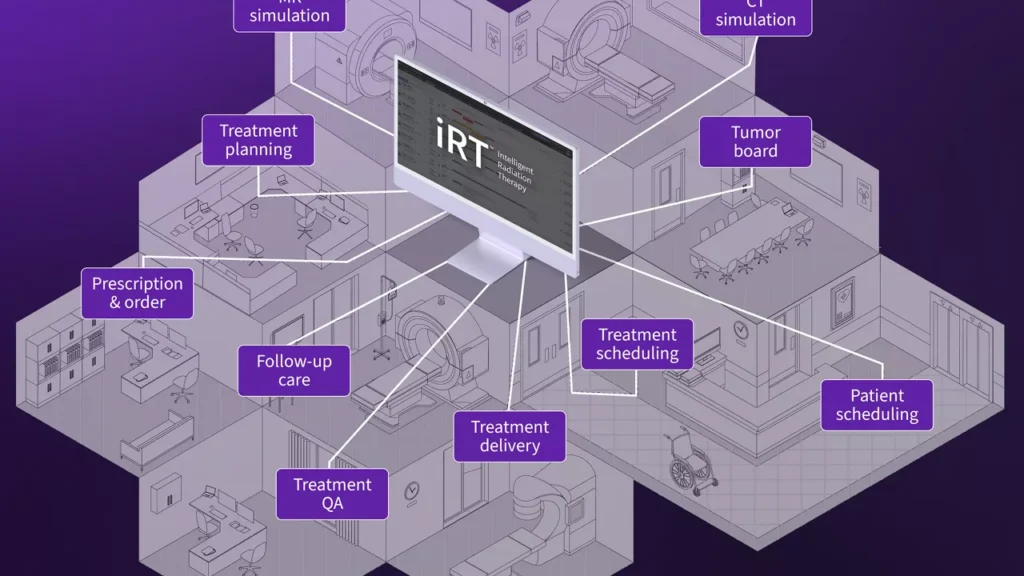
In the interview below, Dr. Tolakanahalli talks about how these dynamics inspired her to work on an integrated RPT workflow platform in collaboration with GE’s iRT for Theranostics offering. Rather than replacing existing clinical systems, iRT for Theranostics is designed to connect existing systems, so that patient information, treatment prescriptions, scheduling, imaging, documentation, and follow-up activities remain coordinated throughout the care pathway.
Many RPT hurdles come from handoffs, rescheduling, and dependencies across teams. In your experience, where does a shared workflow platform create the most immediate operational value: preventing missed workflow steps, improving visibility across teams, or making accountability clearer?
For me, the most immediate value is visibility, because once the workflow is visible, it becomes easier to prevent missed steps and to know who needs to act.
Today, many RPT programs still rely on manual coordination using spreadsheets, phone calls, emails, and messaging between departments. That approach works when volumes are low, but RPT involves many interdependent steps. A single patient’s treatment may include physician approval, laboratory review, isotope ordering, pharmacy preparation, dose assay, infusion scheduling, room and staff availability. Then there’s also post-therapy imaging, dosimetry, documentation, and planning for subsequent treatment cycles. When one of those steps changes, several others often need to change as well.
The challenge isn’t simply that there are many tasks—it’s that they’re connected. If a treatment is postponed because laboratory values are outside acceptable limits, the infusion appointment, drug preparation, imaging schedule, future treatment dates, and documentation may all need to be updated.
When those changes depend on individual phone calls or emails, the risk of something being overlooked increases. That’s why a shared platform matters. Rather than relying on each team to remember every downstream dependency, the platform gives everyone a common view of the patient’s treatment status. If the dose moves from the hot lab to the infusion room, the team needs a structured way to confirm that the dose, patient, isotope, and prescription all match. The same applies to labs, drug orders, room status, imaging, and required documentation.
We’ve seen this before with radiation oncology that has already gone through a similar evolution. I believe RPT is reaching a similar point. As patient volumes continue to grow, workflow coordination is becoming increasingly important to support safe, efficient and reliable RPT delivery rather than simply serving as an operational convenience.
As RPT programs scale beyond a small number of highly specialized patients, what parts of the workflow become hardest to manage manually, and which parts do you think should be standardized across institutions versus configurable to each center’s operating model?
The hardest part to manage manually is scheduling, because in RPT it includes far more than an infusion slot. Here, we have to account for labs, pre-infusion reviews, the radioactive drug, room and staff availability, post-infusion imaging, future cycles. In some cases, we also have to factor in external beam radiation therapy. Those activities all have to stay synchronized.
When one element changes, the rest may need to move with it. A postponement because of marrow suppression, for example, can trigger a chain of calls to the patient, physician, pharmacy, imaging, and staff. That becomes difficult even at modest volume.
At our institution, we are treating around ten cases a week now, and even at that level the strain becomes visible when schedules change. As new indications are approved and patient volumes continue to grow, manual coordination will not scale.
I believe the critical pieces should be standardized across institutions. That includes patient identification, treatment directives, radioisotope verification, prescribed activity, dose assay, treatment documentation, and required safety checks.
We‘ve seen the field moving towards greater standardization. The purpose is to ensure critical processes are performed consistently and according to nationally recognized quality standards. iRT can help provide a workflow platform that supports consistent coordination, documentation, and standardized operational processes across the RPT care pathway.
A key point: the operational routing should however, stay configurable. Different centers deliver RPT through radiation oncology-led, nuclear medicine-led, hybrid, or dedicated theranostic models. A workflow platform should support a consistent safety framework while adapting to each institution’s governance and clinical practice. So it’s really important that we have a standardized clinical backbone with flexibility around ownership and workflow routing.
“With iRT, we can bring the relevant clinical, imaging, dosimetry, and operational data into a single view, allowing the care team to review what was planned, what was delivered, and how the patient responded so they can make informed treatment decisions.”
Dr. Ranjini Tolakanahalli
RPT seems especially suited to personalization because each cycle generates new information: labs, symptoms, post-therapy imaging, absorbed dose estimates, and tumor burden changes. What are the biggest barriers today to using that information to adapt treatment from cycle to cycle, and where could an integrated platform make that feasible in routine practice?
The biggest barrier is that the information needed to make treatment decisions is fragmented. Laboratory results are in the electronic medical record, imaging is stored in separate systems, dosimetry may be performed in dedicated software, physician documentation is elsewhere, and scheduling is managed independently.
Bringing all of that information together for every treatment cycle is often a manual process. RPT is inherently iterative. The information from a single treatment cycle is useful, but the real value comes from looking at trends across multiple cycles.
Laboratory values can show how hematologic tolerance is evolving, imaging can demonstrate changes in disease burden over time, dosimetry can help us understand cumulative absorbed dose to tumors and normal organs, and the patient’s symptoms provide another measure of treatment tolerance. Looking at these data longitudinally allows the multidisciplinary team to understand not just what happened after the most recent cycle, but how the patient is responding and tolerating treatment over the course of therapy.
The challenge is bringing those longitudinal data points together in a way that supports consistent clinical decision-making. For example, at our institution, we perform post-therapy dosimetry for every patient receiving targeted therapies for prostate cancer. Together with laboratory results, imaging findings, tumor burden, and clinical assessment, that information helps our multidisciplinary team determine whether treatment should proceed as planned, whether dose modifications or delays are needed, and, in selected cases, whether additional focal therapies such as stereotactic body radiotherapy should be considered.
The broader workflow follows the same progression: patient-specific protocol selection before infusion, post-therapy SPECT or PET imaging, image registration, segmentation, dose maps, cumulative follow-up, and toxicity tracking. Those pieces support more individualized care, but only if they can be reviewed together.
With iRT, we can bring the relevant clinical, imaging, dosimetry, and operational data into a single view, allowing the care team to review what was planned, what was delivered, and how the patient responded so they can make informed treatment decisions. Beyond supporting clinical decisions, iRT can also help automate many of the operational tasks that accompany treatment changes. If a cycle is delayed, downstream processes such as laboratory testing, drug ordering, imaging appointments, and future treatment schedules can be coordinated automatically.
Is there anything about RPT care that people outside the field often miss?
People often underestimate how much of the RPT workflow happens after the infusion.
Patients go home with radiation-safety instructions, but the care team also has to think about what happens if that patient later presents at another hospital, needs surgery, or triggers a detector in a public setting. Outside clinicians need to know that the patient recently received a radioactive treatment and how to get guidance.
Post-discharge infrastructure matters too. One practical option is giving patients a card, or eventually a scannable identifier, so outside teams know they recently received RPT and know whom to contact. RPT care spans consultation, eligibility review, prescription, drug ordering, labs, treatment, imaging, dosimetry, follow-up, toxicity monitoring, documentation, and the handoff back into the broader healthcare system.
As more patients receive RPT, those surrounding workflows will matter more. With iRT for Theranostics, we have an opportunity now to build the infrastructure around RPT before patient volumes make the gaps harder to manage. Our goal is not just to deliver the radiopharmaceutical safely, but to make the entire patient journey more coordinated and connected.
- Dr. Tolakanahalli is involved in the iRT for theranostics development program, collaboration between GE Healthcare and MCI. She is a paid consultant for GEHC. ↩︎
- Based on two InstaPlan (iRT + RayStation by RaySearch) clinical studies in Europe based on a total of 20 patients. Any results achieved using InstaPlan may vary based on differences in workflows, patient populations or other factors. ↩︎