
On Chicago’s South Side, only a few miles separate Englewood, where life expectancy hovers around 60 years, from Streeterville, where it approaches 90. The gap, nearly three decades, mirrors the differences between nations. Mark Miller, a regional President at Advocate Health, is working to close it by moving care into neighborhoods, using data models to identify underserved areas and guide the placement of clinics that aim to help prevent emergencies before they happen.
At Sentara Health, Megan Yeager, Senior Vice President of corporate finance, is helping stabilize post-pandemic finances with forecasting tools that detect anomalies before they appear in quarterly reports, allowing leaders to adjust in real time. In Lafayette, regional chief nursing officer Renee Delahoussaye at Ochsner Lafayette General is addressing staff fatigue by using virtual nursing and automated documentation systems that record routine care and help free nurses to focus on patients. And in Michigan, vascular surgeon and service-line leader Vikram Kashyap, Vice President of Cardiovascular Health at Corewell Health, is aligning once-separate cardiac programs through a standardized model powered by risk analytics that support early identification of high-risk cardiogenic shock patients.
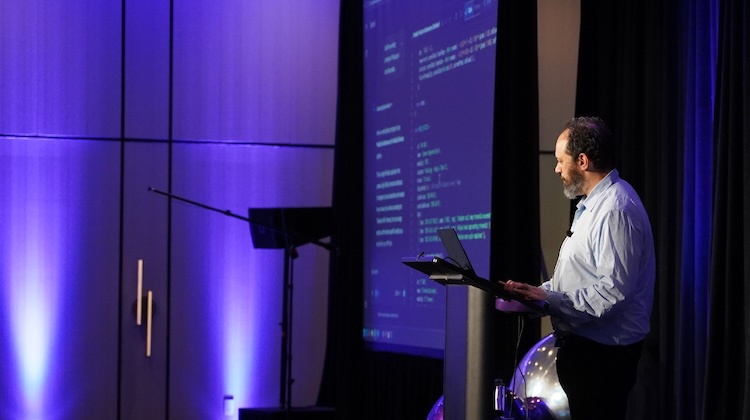
These Fellows, supported by an educational grant by GE HealthCare, represent four disciplines—clinical care, nursing, finance, and administrative—that shape how American healthcare will evolve. They gathered for an annual Leadership Summit hosted by GE HealthCare and the Health Management Academy, a program originally founded to train clinicians in anatomy and injection safety that has since become a hub for collaboration on innovation and leadership skills that will help shape the future of healthcare in the era of AI.1

The realities of data, staffing, and trust in AI
The Summit took place as the industry stands at a crossroads. Healthcare now generates approximately one-third of the world’s data – images, notes, device readings, genomic sequences2– but over 97% of this data remains unused3. Clinicians spend almost half their workday on documentation, and burnout has reached record levels. Labor costs have risen more than 20 percent in a year, and two-thirds of health systems have struggled to maintain full capacity because of staffing shortages. In this environment, AI is not a luxury. It is a necessity, capable of filtering noise, predicting demand, and returning time to clinicians.
That urgency was reflected in the summit’s focus. Sessions explored how algorithms can uncover gaps in access, forecast budget pressures, and simplify administrative work. Examples demonstrated potential impact: predictive models identifying neighborhoods where clinics could help reduce emergency visits, finance copilots correcting budget drift, and automation tools recording nursing care in real time.
However, the thread that tied all the business strategy and technological discussions together was the summit’s overarching theme which was squarely focused on leadership. The 2025 Fellows Leadership Summit focused on providing participants with healthcare executives for an era defined by rapid transformation. With acceleration enabled by the latest advances in AI, shifting workforce demographics, and new care models, the sessions equipped participants with the knowledge needed to move from reactive management to proactive design of the future.
HelloAI Executive and the importance of AI literacy
Sessions at the event highlighted HelloAI Executive4, an educational initiative from GE HealthCare designed to promote responsible AI literacy for senior leaders. HelloAI, which is education – rather than solution or product focused – took center stage at the event to help healthcare leaders develop practical and actionable frameworks for strategic planning and sustainable adoption. Across the industry, about 70 percent of healthcare organizations are piloting or implementing AI, yet few clinicians or administrators have been trained to use it responsibly. HelloAI was designed to help address that gap.
HelloAI offers three learning modules — Foundations, Professional, and Executive — designed for different audiences, from curious learners and healthcare professionals to senior decision makers. Foundations is the starting point for anyone who wants to understand artificial intelligence without needing a technical background. The module offers healthcare professionals, students exploring career opportunities, patients, and AI-curious people information on the terminologies and core concepts in the world of AI.
Professional takes the next step, focusing on practical application for healthcare practitioners and researchers. The module offers pointers to help professionals interpret algorithmic outputs, evaluate diagnostic accuracy, and understand how predictive models influence patient care. The course also highlights the wide range of opportunities and use cases for AI in healthcare, helping participants identify where the technology can create meaningful impact.
Executive is designed for senior leaders and decision makers who need a deeper understanding of how to plan, govern, and drive sustainable AI adoption across health systems. The module emphasizes governance, workforce readiness, and measurable outcomes to ensure AI delivers long-term value.
Together, these modules create a continuum that connects foundational literacy, practical application, and strategic leadership. They turn AI from an abstract concept into a set of skills that empower individuals and organizations to innovate responsibly and lead transformation in healthcare. In the first half of 2025, more than 1,500 learners enrolled, a sign of how fast AI literacy is becoming as fundamental as clinical or financial acumen.
Responsible AI strategy: Vision, impact, risk, and adoption
Discussions at the summit focused on the key factor that drives the success of AI adoption: the importance of matching the rigor of clinical practice. A strong AI strategy answers two questions: How will AI improve care, operations, and outcomes? And how will we do it safely, responsibly, and at scale?
An AI strategy should focus on four core components:
Vision. Setting a clear direction for how AI will support your organization’s broader strategy. It is less about the technology and more about alignment with institutional goals. The aim is to define an AI vision that connects directly to priorities in care delivery, operational efficiency, and growth. Stakeholders should be engaged early to ensure the vision reflects real needs rather than technology for its own sake.
Impact. Proving value through measurable outcomes. This is where vision translates into evidence. Success depends on prioritizing high-value use cases that clearly link to system-level goals such as cost savings, workforce capacity, or patient safety. Validation should follow a staged pathway, beginning with feasibility checks, then technical pilots, and finally patient-facing pilots that demonstrate real-world results.
Risks. Ensuring AI operates within a trusted and ethical framework. Managing risk requires continuous attention to governance, compliance, accountability, and safety throughout the lifecycle — from idea to scale-up.
Adoption. Embedding AI into daily workflows, supported by literacy, change management, and integration. Adoption demands continuous monitoring, feedback loops, and scaling based on evidence. When done responsibly, AI becomes an accepted, reliable part of care and operations.
Together, these components form a complete strategy that moves AI beyond experimentation to responsible, system-wide value. The challenge for healthcare leaders is to apply the same rigor and governance to technology that they expect in clinical care.
Leadership skills for the AI age
The sessions emphasized focusing on business needs rather than getting caught up in technological advancements. The digital leaders of tomorrow will start by identifying the problem they’re solving, understanding what changes when automation enters the picture, and pinpointing where AI can add value.
True digital leaders also start with business needs, not technology. They take time to map workflows, roles, and impacts, understanding how AI fits into the broader system of people and processes. Their attention stays fixed on outcomes, not just features — emphasizing how solutions deliver measurable improvement instead of celebrating technical novelty.
Finally, these leaders create ecosystems that sustain progress. They champion business-aligned AI strategies, design adoption-focused rollouts, and foster iterative learning environments where teams can adapt and improve. Their approach ensures AI supports real goals, builds trust through practical tools, and evolves through feedback loops that refine performance over time.
As the 2025 GE HealthCare and THMA Summit demonstrated, the next generation of healthcare leaders is not waiting for the future. They are shaping it. Across disciplines and regions, they are redefining what it means to lead with purpose by combining data-driven insight with human-centered care. Their work reflects a simple truth: technology alone does not advance healthcare. People do. With the right vision, governance, and education, AI becomes more than a tool — it becomes an ally in the mission to close gaps, restore balance, and create systems that help expand access to care. In an era defined by complexity and change, these leaders are charting a path toward a more connected and compassionate future for healthcare.
- References to AI applications, data tools, and analytics models represent conceptual or educational discussions and may not reflect commercially available products. ↩︎
- https://www.sciencedirect.com/science/article/pii/S2414644724000034 ↩︎
- https://www.weforum.org/stories/2024/01/how-to-harness-health-data-to-improve-patient-outcomes-wef24/ ↩︎
- HelloAI is an educational program designed to support learning. It is not a product or clinical tool and does not provide diagnostic or therapeutic functionality. ↩︎