
Why do people with similar training, discipline and access to instruction still perform differently?
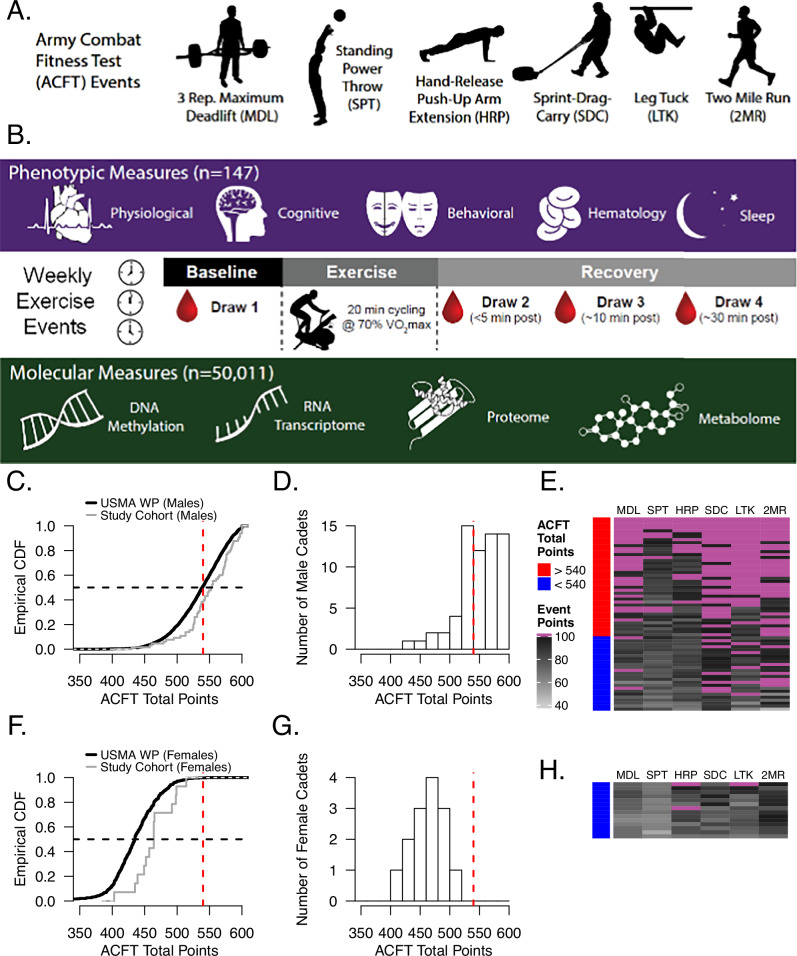
A study led by researchers at GE HealthCare, MIT and the United States Military Academy examined that question in 86 West Point cadets over roughly three months. The researchers, who include Azar Alizadeh and Luca Marinelli, combined standardized fitness testing with measurements of body composition, aerobic capacity, sleep, daily activity and cognition. They also collected repeated blood samples to track biological changes during exertion and recovery.
The molecular analysis examined roughly 50,000 features, including gene activity, proteins, metabolites, immune signaling molecules and routine clinical blood markers. The participants included 71 men and 15 women, most of them 20 or 21 years old. As a group, they performed better on the Army Combat Fitness Test than the broader West Point population.
To analyze the data, the researchers developed a computational framework called PhenoMol. It addresses a recurring problem in molecular medicine: studies can measure tens of thousands of biological signals in a relatively small number of people. Conventional statistical models can find patterns that appear convincing in one dataset but fail when tested elsewhere.
PhenoMol organizes molecules according to established biological relationships and searches for connected groups that vary with a physical outcome.
The findings establish molecular pathways associated with individual physical fitness tests and demonstrate how groups of successful individuals can achieve high performance by leveraging different biological mechanisms. Furthermore, they provide a map for more focused research into training response, recovery, injury risk, healthy aging and disease.
The military setting invites an obvious concern. Was the goal to identify or create unusually enhanced soldiers?
Azar Alizadeh: No. The goal was practical. Some of the military’s most selective programs do not have enough candidates who meet demanding operational standards. The research focused on people who were close to qualifying and asked whether a better understanding of their physical and biological limitations could help them reach the existing standard through more precise training and support.
Luca Marinelli: We were also interested in the different biological strategies people use to perform the same task. One person may rely on strong aerobic capacity. Another may depend more on strength, recovery or metabolic regulation.
Understanding those differences could support more individualized training.
It’s really important to stress that this wasn’t a genomic selection program. The focus was on measurable biology that changes with training, environment and behavior.
Do the molecular pathways identified in the study cause higher performance, or are they signs that someone has trained harder?
Alizadeh: These cadets were already highly trained, and many performed above the West Point average. We were detecting biological differences within a relatively narrow group of healthy, fit young adults who were all working hard.
Some signals may reflect training, while others may reflect underlying traits or differences in adaptation. The study cannot separate those explanations.
One important result is that the model detected meaningful patterns in a small and relatively uniform group. The differences between these cadets were much subtler than the differences researchers might see between healthy people and patients. That suggests the approach may be useful in specialized populations where the signal is modest and large cohorts are difficult to assemble.
Marinelli: The study was not designed to establish causation. We can say that certain biological pathways occurred alongside different levels of physical performance in this cohort. We cannot say that changing one molecule or pathway would improve an Army Combat Fitness Test score.
We identified connected regions of biology that justify targeted experiments. A future study could intervene on a pathway, measure the response and determine whether the relationship is causal.
Which biological findings interested you most?
Marinelli: The prominence of the complement and coagulation pathways was striking. These are groups of interacting proteins that help the body respond to injury. The complement system helps the immune system recognize and clear threats, while the coagulation system helps control bleeding. Both also take part in inflammation and tissue repair.
Hard training creates microscopic muscle damage. The body responds with controlled inflammation that removes damaged material and helps rebuild tissue. In people training repeatedly under heavy load, the ability to manage that cycle may be important to sustained performance.
We also identified bile acid pathways. Bile acids help digest fats but also act as chemical messengers that influence energy use and muscle. Arginine and proline metabolism also appeared. These are amino acids, the small building blocks used to make proteins. Arginine helps the body produce nitric oxide, a signaling molecule that relaxes blood vessels and increases blood flow.
The same network includes the urea cycle, which converts ammonia produced during amino-acid breakdown into urea for removal through the kidneys. The study does not show that changing any of these pathways will improve performance. Their importance will depend on whether other studies reproduce the findings.
The participants were young military cadets. How much can the findings tell us about women, older adults or people with illness?
Alizadeh: We enrolled men and women, but only 14 women had complete fitness scores. That group was too small for the same modeling approach used in the men. The analysis relied on cross-validation, which trains the model in one group and tests it in another. With only 14 women, those groups would have been too small to produce a dependable result.
The women performed significantly better than the broader female population at West Point. A rigorous analysis will require a larger group designed for that purpose.
Marinelli: The same caution applies to age, illness and athletic specialty. A model reflects the population and task from which it was built.
The biology needed for a sprint-drag-carry differs from the biology needed to preserve mobility in old age or compete in endurance events. Some processes may recur, but the details are likely to differ.
Performance studies are also difficult to combine because they often use different tests, sampling schedules and definitions of success. Apparent biological differences across studies may reflect the population, the physical task or the way the measurements were collected.
The framework may be transferable, but the model itself is not automatically transferable. Each population would need to be studied and validated on its own terms.
How did the physical and physiological measures compare with the molecular data?
Marinelli: The phenotype-based models performed very well. A phenotype is an observable or measurable characteristic of a person. In this study, phenotypes included lean muscle mass, body-fat percentage, aerobic capacity, sleep patterns, heart rate and activity levels.
Lean mass and body composition were especially important for strength and power events. VO2 max, which measures how much oxygen the body can use during intense exercise, was more important for the sprint-drag-carry and two-mile run.
These measurements also helped clarify what each event demanded from the body. Some depended heavily on power and muscle mass, while others depended more on aerobic capacity and sustained effort. That makes the phenotype findings more immediately useful for training and test design.
The phenotype models slightly outperformed the molecular models in predicting total fitness scores. If the goal is simply to estimate performance on a known test, measures such as body composition, lean mass and aerobic capacity may already provide much of the useful information.
The molecular models address why people with similar muscle mass, VO2 max and training histories can respond differently to the same workload.
Recovery appears to be an important part of the biological story. What did you observe?
Alizadeh: These cadets were operating under demanding schedules. They trained heavily, attended classes and sometimes participated in long military exercises. Their nutrition and hydration appeared to be well managed. Sleep and recovery were weaker. Average recorded sleep was about six hours for the men and somewhat longer for the women. We also saw injuries and rescheduled study sessions as the workload accumulated.
Young, highly trained people can continue to function under demanding conditions. That does not mean recovery is complete. Muscle damage, sleep debt and cumulative fatigue can continue below the surface.
Marinelli: In many military or athletic settings, the body does not receive the amount of rest that a wearable device or laboratory model would recommend. The person still has to perform.
We need to understand who can tolerate repeated stress and whether there are early signs that someone is moving from productive training toward injury.
What practical applications could grow from this research?
Alizadeh: The framework may help researchers design more focused studies, not only analyze them afterward. Human populations are heterogeneous, and simply combining more data does not remove that problem. A biologically constrained model can help define which population to recruit, which outcome to measure and which assays are worth performing.
That is especially useful in rare disease or early disease, where cohorts are small and biological effects may be subtle.
Marinelli: The immediate application is scientific discovery. We are not at a stage where someone should take a supplement because a pathway appeared in the analysis. The next step is to validate a smaller set of measurements in an independent population and determine whether they add useful information beyond conventional fitness assessments.
In professional sports, the approach could connect force plates, instrumented treadmills, cameras and wearable data with molecular biology to study workload, recovery and injury risk.
In healthy aging, long-term records from at-home devices such as fitness watches, sleep trackers, connected scales, or more sophisticated physiological monitoring can show when someone begins to depart from an expected trajectory. Molecular networks may help explain what biological change preceded a decline in strength or metabolic health.
A longer-term possibility is a compact test built around a small panel of validated biomarkers. Such a tool would need substantial independent testing before it could be used to assess readiness or recovery.
What would convince you that PhenoMol is ready for wider use?
Alizadeh: I would want prospective validation in an independent cohort. The molecular panel and model would need to be defined in advance and tested without revision. The study should include enough women and enough variation in performance for subgroup analysis.
I would also want to know whether the molecular measurements improve decisions. A model can be statistically accurate and still add little to what a coach, physician or physiologist already knows from body composition, aerobic testing and training history.
Marinelli: The strongest validation would connect prediction to action. Can the model identify training response, detect injury risk before performance declines or distinguish temporary stress from a harmful trajectory?
Those are the standards that would turn an analytical framework into a useful clinical or operational tool.