

The GE HealthCare Technology and Innovation Center (HTIC) serves as a centralized research and development hub for the company. This article examines how HTIC’s MRI and Superconducting Magnet Research team—comprising approximately 20 specialists across physics, chemistry, computational sciences and various branches of engineering– has systematically addressed fundamental limitations in brain imaging through a family of high-performance MRI systems. More specifically, we trace the evolution of their technologies across successive investigational devices—from the Compact 3 Tesla (T) system introduced in 2015, through the MAGNUS gradient insert in 2019, and the Compact 7T scanner anticipated for research use in 2025.
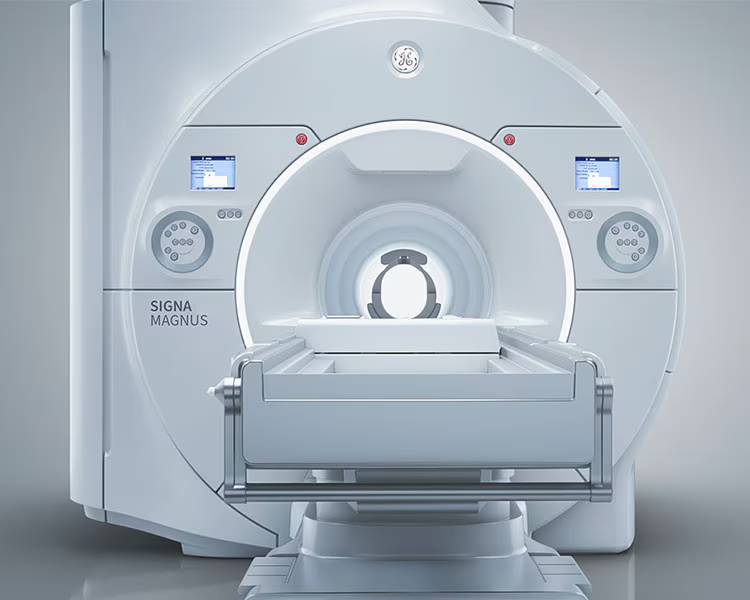
The four essential subsystems of an MRI scanner
To appreciate these innovations, it is essential to understand how MRI creates images. At a broad level, an MR system has four components
The Superconducting Magnet is a bedrock of MRI. This incredibly powerful magnet—about 60,000 times stronger (for 3T) than Earth’s magnetic field—aligns hydrogen nuclei in your body’s water molecules like compass needles. What makes this practical is superconductivity: special wires (niobium-titanium) cooled to extremely low temperatures – 4.2 Kelvin (that is, -452 °F!) – using liquid helium. At this temperature, the wires lose virtually all electrical resistance. Once a current is injected into these zero-resistance coils, it can be sustained without additional power, creating a strong, persistent magnetic field essential for MRI.
The RF Transmit System disrupts this alignment of the hydrogen nuclei to create detectable signals. It sends radio frequency (RF) waves that tip the aligned hydrogen nuclei (i.e., spins) in your body’s water molecules, which sets them up for subsequent manipulation to achieve different types of image contrasts. However, these radio waves also generate electric fields that can heat tissues over time—this is measured by the specific Absorption Rate (SAR), which tracks how much energy your body absorbs. At higher magnetic field strengths (e.g., 7T, which is about 140,000 times stronger than Earth’s magnetic field), more advanced multi-channel RF transmit architectures and software are needed to greatly minimize any local, concentrated heating in tissues.
The Gradient System provides spatial encoding of spins—essentially MRI’s GPS. By creating controlled magnetic field variations across the imaging volume, each location is encoded with a unique frequency and phase signature. Imaging performance is enhanced with higher gradient amplitudes (strength of gradient fields) and slew rates (switching speed of gradient fields).
The RF Receive System captures the faint MR signals emitted as the spins precess – the wobbling motion of hydrogen nuclei spins when they are placed in a strong magnetic field. Arrays of sensitive antennas, called receive coils, surrounding the anatomy collect these signals. Advanced software then processes the raw data to reconstruct detailed medical images.
Establishing foundational technologies for MRI
HTIC’s MRI laboratory has shaped the field since the 1980s, transforming early 0.5-0.7T scanners with limited image quality into today’s sophisticated systems. The lab pioneered whole-body MRI at higher magnetic fields, establishing 1.5T as the enduring clinical standard worldwide.
The laboratory developed groundbreaking technologies that transformed MRI’s clinical capabilities. The RF birdcage coil works like an antenna that sends and receives radio waves uniformly throughout the body, ensuring consistent image quality across the entire scan. Phased array RF receive coils function like multiple antennas working together, capturing clearer signals that produce sharper images in less time. Field shaping arrays correct the radio wave patterns that can become distorted in powerful magnets, while dynamic shimming actively adjusts the magnetic field during scanning to prevent image warping and ensure anatomical accuracy.
Over the past 15 years, HTIC has pioneered another revolution: dramatically reducing MRI’s dependence on liquid helium. Traditional systems require 1500-2000 liters of liquid helium, which is a non-renewable resource that is increasingly scarce and expensive. HTIC’s 2011-2012 breakthrough in advanced cryogenics systems technology reduced liquid helium requirements by 99%. This innovation culminated in the investigational Compact 3T system in 2015 that uses only 12 liters of sealed helium, proving that sustainable, high-performance MRI was achievable.
Working backwards from clinical outcomes: How HTIC solves complex problems
HTIC engages clinical collaborators to advance the frontiers of medical technology to deliver transformative outcomes for patients. For example, through close partnerships, a critical challenge was jointly identified: imaging brain microstructure to detect disease earlier, identify subtle injuries, and monitor treatment response with unprecedented precision.
To address this, HTIC explored advanced imaging techniques such as:
- Oscillating Gradient Spin Echo (OGSE): which enhances sensitivity to microstructural changes, offering insights critical for tumor grading and treatment planning
- Axonal Diameter Imaging (AXDI): that enables evaluation of white matter integrity, providing valuable information on brain development, learning, and changes in connectivity due to disease or rehabilitation.
- Simultaneous Coherent and Incoherent Motion Imaging (SCIMI): which tracks neurofluid dynamics involved in waste clearance and inflammation—processes linked to conditions like hydrocephalus, Alzheimer’s disease, and traumatic brain injury.
These techniques use special types of MRI scans that produce information about tiny structures less than 10 micrometers (about 1/10 the width of a human hair) and detect very slow fluid movements of less than 100 micrometers per second. However, capturing this level of detail requires extremely powerful gradients (≥200 mT/m strength, >500 T/m/s speed) that full-body MRI scanners cannot achieve as they would cause uncomfortable nerve stimulation in the body. Clearly, a new paradigm was needed.
The breakthrough insight: Less is more
The team recognized that in a smaller, head-only system, stronger and faster switching gradient fields can be used safely because of a higher nerve stimulation threshold in the head as compared to the body. The team also recognized early on that technology excellence alone isn’t enough. To truly transform clinical practice, a head-only scanner must not only surpass the performance limits of traditional MRI machines – it must also be easier and more cost-effective to install and operate. This realization shaped HTIC’s three-dimensional approach to innovation in neuroimaging systems—balancing performance, usability, and scalability.
Building a framework: Three dimensions of innovation
The team’s strategic framework for neuroimaging innovation operates along three essential dimensions that must work in harmony for clinical success.
- The first dimension, access, recognizes that even the most advanced technologies will have limited impact if hospitals cannot install or afford it, e.g., traditional 7T scanners demand purpose-built facilities with reinforced floors for 20-40 tonne magnets and massive cooling infrastructures.
- The second dimension, gradient performance, addresses the fundamental limitation preventing visualization of brain microstructure: the PNS thresholds for whole-body gradients significantly limits the usable range of gradient performance compared to head-only gradients.
- The third dimension addresses the engineering and infrastructure challenges in increasing the static magnetic field of magnets to produce images with higher signal-to-noise ratio (higher quality images).
From vision to reality
The evolution of HTIC’s neuroimaging systems demonstrates how systematic innovation progressively addresses these dimensions. The investigational Compact 3T system (2015) proved that low-cryogen technology could work reliably in a clinical setting. Weighing 2 tonnes – less than one-third of conventional 3T scanners – it uses an innovative magnet with less than 12 liters of sealed liquid helium versus 1500-2000 liters in traditional systems (easier, less costly to install and maintain). The gradient coil can produce a maximum gradient strength of 80 mT/m and a gradient field switching rate of more than 700 T/m/s, resulting in higher quality images with less distortions that can confound diagnosis.
An investigational MAGNUS gradient insert (2019), funded by the Congressionally Directed Medical Research Program (CDMRP), represented the next evolutionary step, addressing access and gradient performancesimultaneously. The design delivers remarkable power efficiency—four times higher than standard gradients—delivering 300 mT/m strength and 750 T/m/s using a 2 MVA gradient driver per axis. This enables ultra-detailed brain scans in half the usual time while revealing cellular-level information that is invisible to standard clinical MRI scanners. The additional information will help clinicians understand brain function, structure and pathologies better. Notably, this capability is attained without a need to upgrade existing power infrastructure that already supports 3T whole-body scanners. GE HealthCare has recently achieved FDA 510(k) clearance and is pursuing a commercial release of this high-performance, head-only 3T system.
The investigational Compact 7T system (2025) culminates HTIC’s strategic vision, addressing all three dimensions. Developed through NIH funding with Mayo Clinic and UCSF, the system can fit within a standard 3T magnet room, eliminating the need for costly infrastructure upgrades. Weighing just 8 tonnes – compared to the 20-40 tonnes typical in whole-body 7T systems – it uses only 18 liters of permanently sealed helium, a dramatic reduction from the 2000 liters required in conventional 7T systems. Its advanced cryogenics systems eliminate complex venting systems that can increase installation costs significantly, especially in complex building structures. The high-performance gradient coils, combined with 7T’s superior signal quality, could one day potentially deliver superior research-grade brain imaging in everyday clinical practice.
HTIC’s approach offers a powerful blueprint for advancing medical technology—beginning with the identification of critical clinical needs, addressing foundational scientific challenges, and ensuring that innovations are practical, scalable, and ready for real-world adoption. By balancing near-term clinical needs with transformative long-term research, the team continues pushing boundaries while staying grounded in translating innovations to improve patient care.