

Clinical professionals at the University of Debrecen, one of Hungary’s most advanced cancer centres, see 150-200 patients daily. These included a glioblastoma patient, whose journey from consultation to first treatment spanned 18-21 days, requiring manual multi-system registration, paper-based prescriptions, and 4-6 hours of physician contouring time. Another breast cancer patient faced similar 14-16 day delays with redundant data entry across disconnected systems, resulting in error rates up to 8% in treatment parameters.
In this case study, we will examine how the University of Debrecen’s Radiotherapy Department transformed these lengthy, error-prone workflows through the implementation of GE HealthCare’s intelligent Radiation Therapy (iRTTM) platform. In addition to being a customer of the iRT platform, the University of Debrecen also partners with GE HealthCare to provide feedback on new features when they become available.
The department treats approximately 2,500 new cancer patients per year (based on recent records from 2019-2025) and delivers more than 85,000 treatment fractions in that period.
The technical infrastructure comprises four Elekta linear accelerators: one Versa HD (offering high-definition beam shaping for precise tumour targeting), one Synergy (providing real-time image guidance during treatment), and two Versa HD-RS systems (combining both capabilities for the most complex cases). These machines enable delivery of sophisticated techniques, including VMAT (volumetric arc therapy that sculpts radiation beams around tumours while sparing healthy tissue), SRT (stereotactic radiotherapy for small brain lesions with millimetre accuracy), and SBRT (body-focused high-dose treatments completed in just 1-5 sessions instead of traditional 6-week courses).
This sophisticated infrastructure operates within a complex multi-vendor software ecosystem: MOSAIQ manages the entire patient journey from scheduling to treatment, RayStation calculates optimal radiation dose distributions, MVision uses artificial intelligence to automatically identify organs that need protection, Mobius3D double-checks treatment plans for safety, and dual PACS systems store and retrieve the thousands of medical images generated daily.
Pre-iRT workflow challenges
Dr. Árpád Kovács, Head of the Radiotherapy Department, identified three critical challenges impeding optimal patient care delivery.
First, the department faced systemic issues with patient referrals, as radiotherapy remained inadequately integrated into broader oncology care pathways. Second, the high-expertise requirements of operating multiple sophisticated systems contributed to bottlenecks in workflow efficiency. Third, the persistence of paper-based information exchange, particularly with external referring facilities, resulted in delays, transcription errors, and incomplete data capture.
Critical metrics such as task completion time, quality levels, delay durations, and door-to-door patient time remained unmeasured, limiting the department’s ability to identify and address workflow inefficiencies systematically.
How University of Debrecen improved workflow efficiencies with GE HealthCare’s iRT platform
Enter iRT: Intelligent workflow orchestration
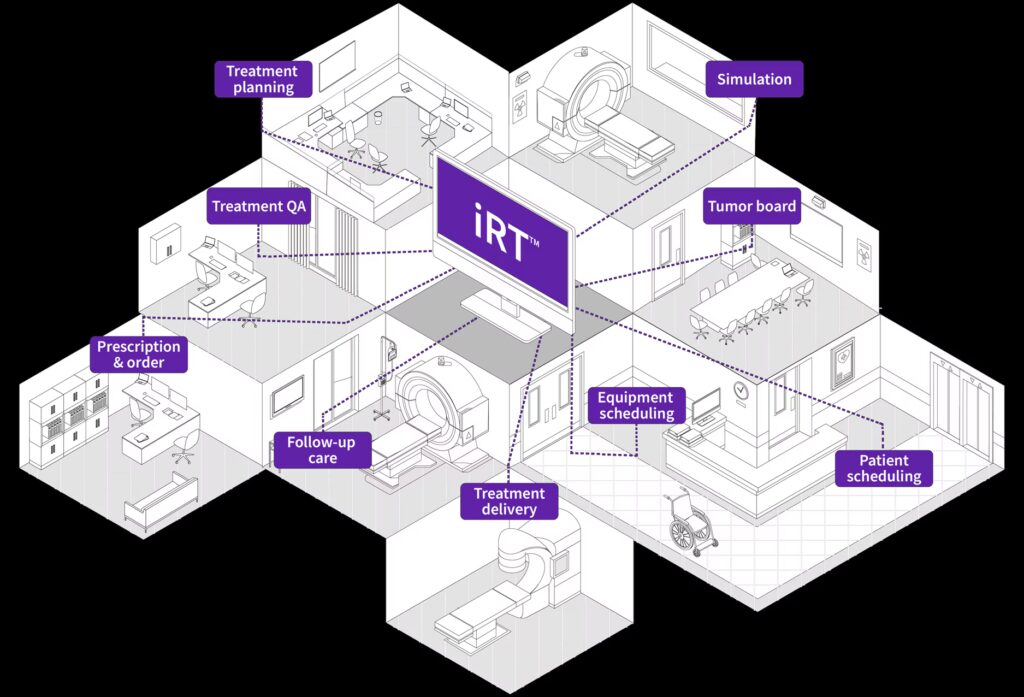
iRT is a radiation therapy collaboration system desgned for interoperability, configured to connect with treatment planning, imaging, and hospital information systems.
Unlike siloed systems, iRT integrates multi-vendor applications, helping reduce compatibility issues that can delay treatment. Developed with input from over 150 clinicians worldwide, it unifies workflows for oncologists, medical physicists, dosimetrists, and radiologists, covering the patient journey from diagnosis to follow-up.
iRT provides centralized control of radiation therapy workflows through a single interface, integrating systems such as Oncology Information System (OIS), Picture Archiving and Communication System (PACS), Electronic Medical Record (EMR), Treatment Planning System (TPS), and Quality Assurance (QA) platforms. By selecting only relevant datasets, it helps reduce redundancies, while built-in communication tools enable clinicians to track progress and collaborate in real time. The offering can also support clinicians in guiding patients along appropriate pathways based on diagnosis and treatment intent.
The deployment of iRT transformed the challenges identified by Dr. Kovács into automated workflows in several areas:.
Outcomes
Automated patient registration
When patients are registered in MOSAIQ, iRT helps capture the data through HL7 messaging and distributes it across the entire ecosystem, removing the need for manual transcription and virtually eliminating errors.
Patient consultation
iRT generates DICOM Worklist entries for their Siemens CT simulator. These electronic worklists act like a digital schedule, automatically providing the scanner console with the correct patient information—such as name, ID, and exam details—without requiring staff to manually re-enter data or rely on paper forms. By streamlining this step, the system not only helps support accuracy but also removes the former need to physically transfer patient folders between buildings, a practice that often introduced avoidable delays in patient preparation.
Intelligent task management
The Course Directive module centralises patient information to coordinate care from early detection to post-treatment. Role-based access control ensures accountability—physicians see only their assigned tasks while others remain greyed out. It enables clear, straightforward, protocol-compliant question-and-answer communication. This helps reduce unnecessary rounds of information exchange (such as phone calls or in-person consultations) and ensures transparent, well-structured task management.
Seamless imaging workflow
CT acquisitions automatically send images to dual PACS systems while MPPS messages update patient status in near real-time. The platform queries relevant series and enables rapid QA.
Automatic CT import
Allows clinicians to immediately verify whether CT scans are suitable for treatment planning. This function is especially valuable in situations where target volumes or organs at risk (such as the bladder or rectum) may change dynamically, since inappropriate sizing could otherwise require a repeat scan. By enabling instant confirmation by the clinican the system reduces the likelihood of recalling patients for additional CT acquisitions, streamlining preparation and minimizing delays.
AI-Powered contouring by hosted applications
iRT submits CT datasets to MVision for OAR (organs at risk; manufactured by XRTMedical) delineation, completing segmentation in just minutes. OAR delineation means outlining sensitive organs near the tumor so they can be protected during treatment. This capability is made possible through GE HealthCare’s close partnership with MVision, where a dedicated API—an application programming interface that allows different systems to exchange data—was jointly collaborated on to enable seamless integration of the contouring process. Once segmentation is completed, RTSTRUCT files, which are standard DICOM files that store the contour data, are automatically forwarded to both PACS (image storage systems) and RayStation® TPS (treatment planning software developed by RaySearch).
Treatment planning
Planners open RayStation with patient data and AI-generated contours already in place, eliminating the previous bottleneck of transferring folders back to physics for manual importing. With iRT, this delay is substantially reduced. Plan Intent forms standardize prescriptions, such as the 4005 cGy breast cancer template, helping ensure accuracy and consistency.
Real-time progress tracking
With iRT, the Patient Racetrack visualisation has replaced Excel sheets and Python scripts with color-coded workflow status, showing completed, in-progress, and pending tasks at a glance. With iRT, patient data and the current status of each patient’s treatment process are consolidated into a single interface, making the workflow easy to manage and oversee. Since a physician may be responsible for dozens of patients undergoing treatment simultaneously, this greatly facilitates tracking and monitoring their progress.
Measurable impact and outcomes
The benefits of iRT become most apparent when examining its measurable impact on the department’s clinical performance and operational efficiency.
Workflow transformation
The measurable results of iRT’s implementation can best be seen in how it reshaped the department’s operations, turning formerly fragmented processes into a unified, data driven system.
Prior to iRT, the department relied on Excel-based tracking sheets and custom Python scripts they had developed in-house for workflow monitoring, with daily email reports showing only basic metrics like treatment time on LINAC machines and patient counts. The platform’s automated task routing and real-time Patient Racetrack visualization now provide comprehensive visibility into all 9 workflow steps, with precise timestamps showing when each task was initiated and completed. The standardization achieved through iRT is particularly evident in their treatment evolution data: VMAT procedures exploded from 35 to 1,022 cases.
Clinical efficiency gains
Since 2016, the department has experienced substantial growth in advanced techniques. VMAT procedures increased from 35 to 1,022, SRT rose from 0 to 131 cases, and SBRT expanded from 0 to 122 cases by 2024. Together, these modalities (VMAT, SRT, and SBRT) represented 1,275 treatments annually, while conventional 3D therapy has decreased by 33.6% over the same period.
By 2025, VMAT became the dominant approach at 85% of all procedures, making advanced techniques essential for high throughput. The patient population evolved in complexity, with metastatic and secondary tumors now representing the largest category at 26% of cases. The diverse caseload includes breast and lung cancers each at 17%, followed by GI, prostate, GYN, head and neck, and CNS tumors.
The iRT™ ecosystem Health Services, provides simplified access to an intuitive visualization of patients’ longitudinal history, current care status, and next tasks to complete. In addition to robust iRT -specific applications, clinics have the flexibility to integrate their current or preferred applications.To support the increased complexity, the department integrated AI-powered MVision technology, which completes organ-at-risk segmentation in minutes, streamlining the previously labor-intensive contouring process. By reducing contouring time by up to 95% and standardizing results across 300+ structures, MVision AI’s GBS™ helps clinicians handle higher caseloads without compromising precision or guideline compliance.
Quality assurance enhancement
iRT’s enforcement of systematic workflow checkpoints has strengthened the department’s quality assurance program. The two mandatory daily QA reviews—occurring after consultation and after planning with all patients reviewed—are now digitally tracked and timestamped.
Data-driven decision making
Perhaps most significantly, iRT has transformed University of Debrecen from a department with a workflow satisfaction rating of 6.5/10 to one with comprehensive operational visibility across 8+ integrated systems (UDMed, MOSAIQ, RayStation, MVision AI, eRAD PACS, in-house PACS, and custom scheduler). The platform now captures metrics that were not routinely measured that Dr. Kovács identified as critical: time to complete workflow tasks, duration of delays, owner of delayed tasks, door-to-door patient time, and first diagnosis to treatment intervals.
Dr. Kovacs says:
“The complexity of all systems involved in iRT made it hard to have an overall view of the patient pathway in the department,iRT has fundamentally changed this—we now have complete visibility and control over every aspect of our workflow, from initial consultation through treatment delivery.”